





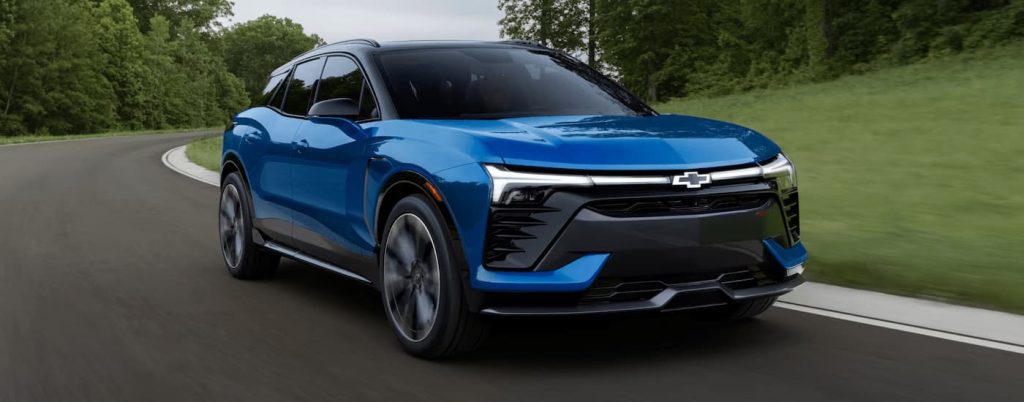
If you’re looking for a crossover EV that’s both sporty and practical, the 2024 Chevy Blazer EV and 2024 Ford Mustang Mach-E are a great place to start. Inspired by some of their brands’ most iconic models, these two crossovers prove that established automakers are well on their way to perfecting the EV formula. The boring, minimalist EVs are on their way out, steadily being replaced by a new generation of models that prioritize design and performance just as much as efficiency and sustainability.
Those in the market for a Mustang Mach-E or Blazer EV for sale have probably noticed similarities between the two. The most obvious parallel might be their styling, as the Mach-E’s Mustang-inspired heritage is right there in the name, but Chevy has taken a more subtle—and decidedly less misleading—approach. The Blazer EV borrows more than a few styling cues from Chevy’s storied Camaro muscle car but, unlike Ford, didn’t risk confusing drivers by leaning too heavily on the name.
Most drivers are unlikely to mistake this midsize SUV for the low-slung muscle car, but in resisting the urge to weaponize the Camaro name, Chevy has decided to let the Blazer EV stand on its own merits. So, how do these two game-changing EVs compare in performance, range, and interior tech, and which one is the right choice for you? Read on as we explore the finer points of the 2024 Chevy Blazer EV and 2024 Ford Mustang Mach-E and see if they have the goods to back up their muscle car-inspired styling.

Performance
With the 2024 Blazer EV, Chevy has created one of the most versatile midsize crossover EVs on the market. The lineup is packed with a variety of drivetrains, allowing drivers to customize their 2024 Blazer EV to their unique driving needs. It all starts with the entry-level LT trim, which is available in either front- or all-wheel drive. The all-wheel-drive model is powered by two robust electric motors that allow the crossover to produce some 288 hp, slotting it above many of its rivals in the midsize EV segment. Couple that with 333 lb-ft of torque, and you’ve got a potent package that’s a relative bargain at just over $57k.
Stepping up a level, the all-wheel-drive RS matches the LT’s 288 hp while throwing some larger wheels and handsome styling upgrades into the mix. For those seeking a little more in the way of high-speed excitement, there’s the RS in a rear-wheel-drive guise. This RS nixes the dual-motor approach for a single, upgraded motor that delivers power directly to the rear wheels, creating 340 hp and providing some peppy acceleration that’s a noticeable step up from the AWD version.
Then there’s the SS trim. Chevy didn’t have to create a 557-hp, 648-lb-ft-of-torque version of the family-friendly midsize SUV, but as soon as you put the pedal to the metal for the first time, you’ll surely be glad they did. The all-wheel-drive SS is a standout in the segment. Packed with a host of upgrades—including massive 22-inch wheels and restyled bodywork—the SS is worth a second look for any driver looking for an edge-of-your-seat EV experience. Fledgling electric brands might have proved just how thrilling an all-electric SUV can be, but with models like the Blazer EV SS, orthodox automakers like Chevy now seem to be on a mission to beat them at their own game.
While the Mach-E might wear the storied Mustang badge, don’t let this model’s pony car heritage fool you: the Mach-E is a crossover EV through-and-through. The Mach-E does recall the original Mustang in its sporty styling, but long-time fans of the original pony car will probably be a little underwhelmed if they’re expecting the crossover to live up to the thrills of its namesake. That’s not to say the Mach-E is a boring ride; the range-topping GT Performance Edition packs enough horsepower to speed drivers from zero to sixty in just under four seconds, and a new, off-road-focused variant dubbed the Rally is likely to match that—but at 266/290 hp, the same can’t be said for many of the lower trims.
On the performance front, the Mach-E is also a little underwhelming when it comes to customization. Drivers can choose between a standard-range, 70-kWh battery or a 91-kWh extended-range pack—and while all of the trims come with optional AWD, the Mach-E simply can’t compete with the Blazer EV when it comes to pure power and torque. We certainly understand trying to capitalize on the Mustang name, but Ford has cut some corners in the name of adapting a pony car for the crossover segment.
Range
All the power in the world doesn’t amount to much if you run out of juice halfway through your drive. While range was once a limiting factor in the EV segment, the times are changing, with 300 miles of range becoming the norm across much of the industry. So, how do the 2024 Chevy Blazer EV and Ford Mustang Mach-E compare when it comes to range?
Let’s start with the Blazer EV, which delivers an impressive 279 miles for the AWD versions of the LT and RS trims. Opting for rear-wheel drive makes the RS the long-distance runner of the lineup, giving drivers 324 miles of all-electric enjoyment. Then there’s the range-topping SS. While we’re still awaiting the crossover’s official EPA-estimated rating, Chevy has hinted that the SS will get just south of 300 miles of range on a single charge, likely clocking in around 290 miles.
The 2024 Blazer EV also comes with the latest and greatest in the automaker’s charging technology, gaining as much as 78 miles of range in ten minutes when connected to a DC Fast Charger. That sort of speed is an important factor to many EV drivers who don’t want to sacrifice convenience in the name of sustainability.
When it comes to the Ford crossover’s range, the 2024 Mach-E maxes out at 312 miles in the California Route 1 trim. The Mach-E Premium comes in a close second at 310 miles, but only when optioned as a rear-wheel drive model. If you’re looking to experience one of the Mustang’s sportier trims, be prepared to sacrifice some range with the GT trim offering just 270 miles per charge. That number drops to 260 miles with the GT Performance trim, which might seem like a fair trade-off until you consider that the Blazer’s SS trim will probably surpass that number by some 40 miles while offering similar performance.
Ford started experimenting with some new battery chemistry on some 2023 Mach-E models, and while anything would be an improvement over the previous Standard Range battery’s maximum range of 226 miles offered on some of last year’s entry-level models, we’re not exactly blown away by the 2024 version’s 250 mile range. The Standard Range battery should be serviceable if you’re the type of driver who generally sticks to commuting and running errands around town, but with a maximum range of 250 miles for the Select trim, longer road trips could be a little heavy on the pit stops.

Interior
Chevy has taken some real chances with the Blazer EV, and it certainly pays off when it comes to the interior. This midsize crossover comes with a long list of amenities like heated and ventilated front seats, heated rear seats, and ambient lighting, but it’s this EV’s design and tech features that really set it apart from the crowd. The Mach-E might lean heavily on the Mustang name, but if you were to blindly plop a driver behind the wheel, it’s hard to see anyone pegging Ford’s EV as the sportier of the two. From the two-tone color scheme and red accents to the thick, Camaro-like steering wheel and cockpit-like dashboard design, the Blazer EV evokes a sense of speed even when you’re sitting in the driveway.
This can largely be credited to the SUV’s 17.7-inch touchscreen display, which, aside from being simply massive, is also angled toward the driver in a pleasingly ergonomic manner. The 11.0-inch digital instrument display, AC vents, controls, and storage cubbies have all been designed to match the Blazer EV’s sporty aesthetic, creating a dynamic interior that’s a pleasant departure from some of the more restrained styling we’ve seen from the rest of the segment. Some drivers might find the approach a little overwhelming, but it definitely lends itself to an engaging ride.
Ford’s EV covers all the expected bullet points—15.5-inch touchscreen, Apple CarPlay, Android Auto, wireless device charging, a mobile Wi-Fi hotspot, and available premium sound system—but the overall execution is a bit lacking. The Mach-E’s interior is just a bit bland, especially when compared to the noticeably sporty styling of the Blazer EV. Let’s use the 15.5-inch touchscreen as an example: this display runs on Ford’s Sync infotainment platform, which, to its credit, is now employing machine learning to create a bespoke experience for up to four different drivers, but its placement and orientation seem like an afterthought.
Ford has vertically mounted the screen, giving it a portrait-like orientation that resembles an oversized iPad. This sort of interface might be familiar and intuitive to many drivers, but the placement just doesn’t make sense in this sort of automotive application. Those in the passenger seat might appreciate the view, but the screen will seemingly be less-than-convenient to view and interact with for those behind the wheel. It might seem like a minor gripe, but it speaks to an overall lack of polish that’s reflected throughout the rest of the cabin.
The Mach-E’s dash is also noticeably bare when compared to many of its segment rivals. Aside from the touchscreen display and a small digital instrument cluster display, the Mach-E’s dash is somewhat bland. Clean, minimalist interiors might be the hallmark of the EV segment, but slapping the Mustang name onto a model comes with certain expectations in terms of style and sportiness. The Mach-E largely fails to meet these expectations, especially when compared to the Blazer EV.
The Blazer EV Over the Mustang Mach-E
Performance, range and amenities aside, the Mach-E Mustang and Blazer EV do differ in a few other important ways. The most notable would have to be the price. While the entry-level version of Chevy’s EV offering retails for around $10k more than Ford’s. Given the Blazer EV’s superior range, horsepower, and interior design, the price seems to be justified—and that’s not even factoring in the potential savings in the form of state and federal EV tax credits. The government’s incentives allow drivers to knock $7,500 off the price of a new EV and as much as $4,000 off a used model, bringing the Blazer EV’s total price under the all-important $50k mark.
Ultimately, it will be up to drivers to choose between the two models. Those looking to save a few bucks and invest in a relatively run-of-the-mill crossover EV experience will likely be satisfied by the 2024 Mustang Mach-E, but it’s hard to make a case for the Ford in a world where the Blazer EV exists. Besting the Mustang Mach-E in virtually every category, the Blazer EV marks an exciting new entry that—fingers crossed—is just a small taste of Chevy’s all-electric future.
Connect with us


- July 2026
- June 2026
- May 2026
- April 2026
- March 2026
- February 2026
- January 2026
- December 2025
- November 2025
- October 2025
- September 2025
- August 2025
- July 2025
- June 2025
- May 2025
- April 2025
- March 2025
- February 2025
- January 2025
- December 2024
- November 2024
- October 2024
- September 2024
- August 2024
- July 2024
- June 2024
- May 2024
- April 2024
- March 2024
- February 2024
- January 2024
- December 2023
- November 2023
- October 2023
- September 2023
- August 2023
- July 2023
- June 2023
- May 2023
- April 2023
- March 2023
- February 2023
- January 2023
- December 2022
- November 2022
- October 2022
- September 2022
- August 2022
- July 2022
- June 2022
- May 2022
- April 2022
- March 2022
- February 2022
- January 2022
- December 2021
Archives
- 2024 Chevy Blazer
- 2024 Chevy Equinox EV
- 2024 Chevy Suburban
- 2024 Silverado EV vs 2024 Ford F-150 Lightning
- 2025 Chevy Blazer
- 2025 Chevy Blazer EV
- 2025 Chevy Colorado
- 2025 Chevy Colorado vs 2025 Ford Ranger
- 2025 Chevy Equinox
- 2025 Chevy Equinox EV
- 2025 Chevy Silverado 1500
- 2025 Chevy Silverado 2500 HD
- 2025 Chevy Silverado 3500 HD
- 2025 Chevy Suburban
- 2025 Chevy Tahoe
- 2025 Chevy Trailblazer
- 2025 Chevy Traverse
- 2025 Chevy Traverse vs 2025 GMC Acadia
- 2025 Chevy Trax
- 2026 Chevy Colorado
- 2026 Chevy Colorado vs 2026 GMC Canyon
- 2026 Chevy Equinox
- 2026 Chevy Silverado 1500
- 2026 Chevy Silverado 1500 vs 2026 GMC Sierra 1500
- 2026 Chevy Silverado 1500 vs 2026 Ram 1500
- 2026 Chevy Silverado 2500 HD
- 2026 Chevy Tahoe
- 2026 Chevy Trax
- 2027 Chevy Bolt
- 2027 Chevy Silverado 1500
- Bigfoot Chevy Dealership
- Blazer EV for Sale
- Blazer EV for Sale Near San Antonio
- Boerne Chevy Dealer
- Braun's Farm Chevy Dealership
- Budget Cars for Sale
- Castroville Chevy Dealership
- Certified Pre-Owned Chevy Dealer
- Chevrolet Camaro Dealer
- Chevrolet Dealership San Antonio
- Chevy Blazer for Sale
- Chevy Bolt for Sale
- Chevy Colorado for Sale
- Chevy Colorado for Sale In Castroville
- Chevy Colorado for Sale Near Helotes
- Chevy Colorado for Sale Near Hondo
- Chevy Colorado for Sale Near Lakehills
- Chevy Colorado for Sale Near San Antonio
- Chevy Dealer
- Chevy Dealer Near Converse
- Chevy Dealer Near Lakehills
- Chevy Dealer Near Me
- Chevy Dealer Near Pearsall
- Chevy Dealer Near San Antonio
- Chevy Dealer Serving Uvalde
- Chevy Equinox EV Dealer
- Chevy Equinox EV for Sale
- Chevy Equinox EV for Sale Near Castroville
- Chevy Equinox EV for Sale Near San Antonio
- Chevy Equinox for Sale
- Chevy Equinox for Sale Near San Antonio
- Chevy Equinox for Sale Near Uvalde
- Chevy EV Dealer
- Chevy Fleet Vehicles for Sale
- Chevy Malibu for Sale
- Chevy Silverado 1500 Dealer
- Chevy Silverado 1500 for Sale
- Chevy Silverado 1500 for Sale in Castroville
- Chevy Silverado 1500 for Sale Near Fair Oaks Ranch
- Chevy Silverado 1500 for Sale Near Helotes
- Chevy Silverado 1500 for Sale Near Hondo
- Chevy Silverado 1500 for Sale Near San Antonio
- Chevy Silverado 1500 for Sale Near Uvalde
- Chevy Silverado 2500 for Sale Near San Antonio
- Chevy Silverado EV for Sale in Castroville
- Chevy Suburban for Sale
- Chevy Suburban for Sale Near San Antonio
- Chevy Suburban for Sale Near Uvalde
- Chevy SUVs for Sale
- Chevy Tahoe for Sale Near Hondo
- Chevy Tahoe for Sale Near Lakehills
- Chevy Tahoe for Sale Near San Antonio
- Chevy Trailblazer for Sale
- Chevy Trailblazer for Sale Near San Antonio
- Chevy Traverse for Sale
- Chevy Traverse for Sale in Castroville
- Chevy Traverse for Sale Near Helotes
- Chevy Traverse for Sale Near Lakehills
- Chevy Traverse for Sale Near Leon Valley
- Chevy Traverse for Sale Near San Antonio
- Chevy Trax for Sale
- Chevy Trax for Sale in Castroville
- Chevy Trax for Sale Near San Antonio
- Chevy Trucks for Sale
- Chevy Trucks for Sale Near Hondo
- Chevy Trucks for Sale Near Lakehills
- Devine Chevy Dealer
- Electric Vehicles for Sale
- GM Purchase Programs
- Helotes Chevy Dealer
- Hondo Chevrolet Dealer
- Hondo Chevy Dealer
- Leon Valley Chevy Dealership
- Moore Chevy Dealer
- Oak Grove Chevrolet Dealer
- Oil Change
- Oil Change Near Me
- San Antonio Chevrolet Dealer
- San Antonio Chevy Commercial Truck Dealer
- San Antonio Chevy Dealer
- San Antonio Chevy Suburban Dealer
- San Antonio Used Car Dealerships
- San Antonio Used Chevy Dealer
- Sell My Car
- Silverado 2500 for Sale
- Silverado EV for Sale
- Silverado EV for Sale Near San Antonio
- SUVs for Sale
- SUVs for Sale in Castroville
- SUVs for Sale in San Antonio
- SUVs for Sale Near Hondo
- Tahoe for Sale
- Texas Chevy Dealer
- Truck Dealer Near Me
- Trucks for Sale
- Used Car Dealer Near Me
- Used Cars for Sale
- Used Chevy Dealer
- Used Chevy Silverado for Sale
- Used Chevy Silverado for Sale Near San Antonio
- Used Chevy Trucks Near Me
- Used SUVs for Sale
- Used Truck Dealer Near San Antonio
- Used Truck Dealership
- Used Trucks for Sale
- Used Trucks for Sale in Castroville, TX
- Used Trucks for Sale Near San Antonio
- Work Trucks for Sale