





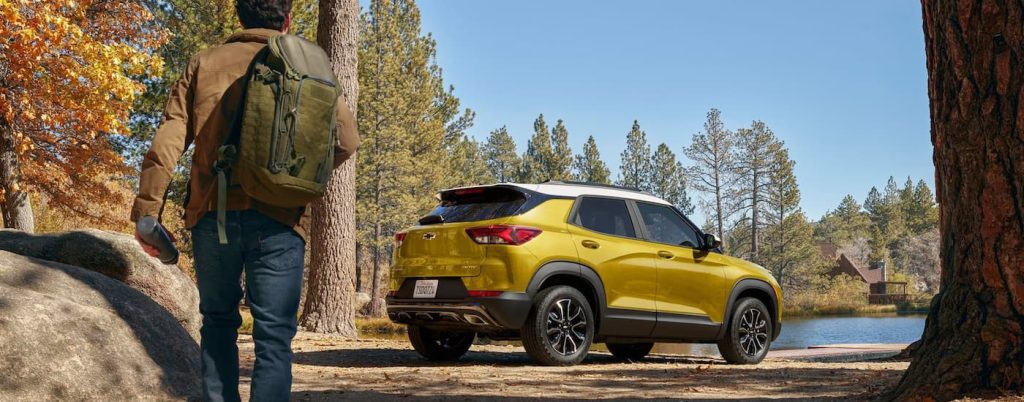
How do you choose between two vehicles that are equally compelling in terms of style, performance, and value? Chevrolet has produced some of the greatest and most popular SUVs in automotive history, and two of the best Chevy SUVs for sale today are the Trailblazer and Trax. And yet, these two models are more similar than anything else in Chevy’s lineup—so what’s distinct enough to warrant contemplation?
The Trax and Trailblazer are Chevy’s two entry-level SUVs, and their price reflects this, with both starting well under the coveted $25k mark. The 2024 Trax is the less costly of the two, with an MSRP of $20,400, and the Trailblazer costs about $1,700 more, with its base trim starting at $22,100.[a] Aside from saving you upwards of $37,000 against Chevy’s priciest SUV, the Suburban, if you’re serious about your savings, the Trax and Trailblazer will also get you incredible fuel economy. But if they’re both affordable and efficient, then what else differentiates them? Well, that’s actually a big question…
What’s the Difference?
We mentioned the Trailblazer has a higher starting price than the Trax because both vehicles are as different as they are similar. The first difference people often want to know about is whether the Trailblazer and Trax perform similarly enough to warrant two separate test drives.
Performance is a double-edged sword for the Trailblazer because it begins as a comparable experience to the Trax, barring one exception: the transmission. The Trailblazer’s base engine comes paired with a Continuously Variable Automatic Transmission (CVT), while the same-sized engine with identical horsepower and torque output in the Trax comes with a six-speed automatic transmission. But, if given the right configuration, the Trailblazer begins to spread its wings; it has a powertrain not available to the Trax in the turbocharged 1.3L I-3 engine.
At a glance, this upgraded engine doesn’t sound like much, given the turbocharged 1.2L I-3 engine it’s replacing. However, with the new all-wheel drive (AWD) option, this stronger engine becomes more of an optimal solution for the average driver. Even if you’re not an off-road person, having AWD can be invaluable in making it safer and easier to drive on roads wet from rain, sleet, ice, etc.
The other benefit of an incrementally larger engine is better performance, which is the case with the turbocharged 1.3L I-3 engine and its 155 hp and 174 lb-ft of torque. It’s a no-brainer to go with the larger engine if you can because of its better fuel economy, getting an EPA-estimated 33 MPG on the highway over the 31 MPG of the 1.2L I-3; both get an EPA-estimated 29 MPG in the city. Note, too, that AWD models don’t come up short, with an EPA-estimated 26 MPG in the city and 29 MPG on the highway.
Before we discuss the similarities between the two, let’s talk about one more difference: infotainment. The multimedia capabilities of every new vehicle are defined by its infotainment system. The Trax can be configured to offer an identical multimedia experience to the Trailblazer, but it doesn’t come that way; many of the features are communal between the two vehicles, even in their base form, but the differences in infotainment centers have a lot to do with screen sizes. Buying a standard Trax means you’re getting an 8.0-inch infotainment touchscreen, although opting to upgrade slides this out for an 11.0-inch touchscreen. Contrarily, the Trailblazer gets the 11.0-incher as its standard.

Spot the Similarity
Both the Trax and Trailblazer come with wireless Apple CarPlay and Android Auto—our favorite examples of how premium wireless tech has become more accessible in recent years. This level of connectivity between smartphones and automobiles might not mean much to some drivers, but what matters to everyone are ultramodern safety features. The Trax and Trailblazer both have Chevy Safety Assist, so when you’re driving either SUV, you’ll have Forward Collision Alert, Automatic Emergency Braking, and Front Pedestrian Braking, along with Lane Keep Assist and Lane Departure Warning.
Ever since Chevy’s focus on safety shifted to its homemade sensing systems, the Chevy Safety Assist suite has been installed up and down the Chevy lineup. Regardless of a price difference of less than $2,000 between the Trax and Trailblazer, Chevy Safety Assist feels more surprising of an addition to the Trax; most automakers would restrict features as great as Chevy Safety Assist to not only be cost-effective but to force buyers to spring for an upgrade to get it, knowing that they very well will. Chevy, instead, lays it straight in their entry-level vehicles, thereby making this kind of tech ubiquitous for future generations.
The other similarity between the Trax and Trailblazer that won’t influence your decision is cargo space. Cargo space differs between the two, but the differences are so minute that they may as well be considered identical.
The 2024 Trax has 25.6 cu.ft. of cargo space with the backseat up and 54.1 cu.ft. when folded down. Again, spending the extra $1,700 doesn’t mean you’re getting any real differences, as the 2024 Trailblazer has cargo space ranging between 25.3 cu.ft. and 54.4 cu.ft. with comparable seat configurations. These two SUVs are some of the most space-efficient subcompact models on the market, with a 111% and 115% increase in space when folding down the backseat—for the Trax and Trailblazer, respectively—and those are some serious numbers for subcompacts.
Key Comparisons
You should care about the similarities between the Trailblazer and the Trax because they help inform your decision unlike any other. The Trailblazer and Trax are separated by a few things—better infotainment interface, extra powertrain option, etcetera—but these vehicles are much more than that. If you’re on the fence between the two, looking only at the similarities, then the clear winner is the Trax because it’s the cheaper of the two. The price differences aren’t massive, but it’s still noticeable that the more cost-effective vehicle still benefits from a turbocharged 1.2L I-3 engine, wireless Apple CarPlay and Android Auto, the Chevy Safety Assist suite, and more.
While the pricing differences are advantageous to the Trax, that doesn’t mean the price increase is a detractor from our recommendation for the Trailblazer. Yes, the Trailblazer costs a touch more than the Trax, but once you’re fitted with a turbocharged 1.3L I-3 engine paired with that nine-speed automatic transmission and all-wheel drive… well, you’ll be hoofing in ways the Trax can only dream of. It’s a small price to pay for adding some of these features on your Trailblazer, but it’s worth it ten times over for the average driver who needs their vehicle for general travel with occasional leisurely drives.

How Do You Want It?
Knowing which model is better for you requires you to consider how the aforementioned will translate into your life. In the simplest of manners, the Trailblazer and Trax are both made for those who need a subcompact SUV; on the base level, these two seem to have been created for the same person. If you’re willing to omit some of the more useful features found on the Trailblazer, like AWD and a wider infotainment interface, you’ll do just fine in a Trax.
However, if you have a few extra bucks to invest in the Trailblazer, you should do it. Choosing a Trailblazer not only gives your vehicle more room to expand its capabilities but also helps its longevity, as much in regard to what you need it for as to its potential resale value down the line.
[a]MSRP may change without notice. See the dealer for complete details.
Connect with us


- July 2026
- June 2026
- May 2026
- April 2026
- March 2026
- February 2026
- January 2026
- December 2025
- November 2025
- October 2025
- September 2025
- August 2025
- July 2025
- June 2025
- May 2025
- April 2025
- March 2025
- February 2025
- January 2025
- December 2024
- November 2024
- October 2024
- September 2024
- August 2024
- July 2024
- June 2024
- May 2024
- April 2024
- March 2024
- February 2024
- January 2024
- December 2023
- November 2023
- October 2023
- September 2023
- August 2023
- July 2023
- June 2023
- May 2023
- April 2023
- March 2023
- February 2023
- January 2023
- December 2022
- November 2022
- October 2022
- September 2022
- August 2022
- July 2022
- June 2022
- May 2022
- April 2022
- March 2022
- February 2022
- January 2022
- December 2021
Archives
- 2024 Chevy Blazer
- 2024 Chevy Equinox EV
- 2024 Chevy Suburban
- 2024 Silverado EV vs 2024 Ford F-150 Lightning
- 2025 Chevy Blazer
- 2025 Chevy Blazer EV
- 2025 Chevy Colorado
- 2025 Chevy Colorado vs 2025 Ford Ranger
- 2025 Chevy Equinox
- 2025 Chevy Equinox EV
- 2025 Chevy Silverado 1500
- 2025 Chevy Silverado 2500 HD
- 2025 Chevy Silverado 3500 HD
- 2025 Chevy Suburban
- 2025 Chevy Tahoe
- 2025 Chevy Trailblazer
- 2025 Chevy Traverse
- 2025 Chevy Traverse vs 2025 GMC Acadia
- 2025 Chevy Trax
- 2026 Chevy Colorado
- 2026 Chevy Colorado vs 2026 GMC Canyon
- 2026 Chevy Equinox
- 2026 Chevy Silverado 1500
- 2026 Chevy Silverado 1500 vs 2026 GMC Sierra 1500
- 2026 Chevy Silverado 1500 vs 2026 Ram 1500
- 2026 Chevy Silverado 2500 HD
- 2026 Chevy Tahoe
- 2026 Chevy Trax
- 2027 Chevy Bolt
- 2027 Chevy Silverado 1500
- Bigfoot Chevy Dealership
- Blazer EV for Sale
- Blazer EV for Sale Near San Antonio
- Boerne Chevy Dealer
- Braun's Farm Chevy Dealership
- Budget Cars for Sale
- Castroville Chevy Dealership
- Certified Pre-Owned Chevy Dealer
- Chevrolet Camaro Dealer
- Chevrolet Dealership San Antonio
- Chevy Blazer for Sale
- Chevy Bolt for Sale
- Chevy Colorado for Sale
- Chevy Colorado for Sale In Castroville
- Chevy Colorado for Sale Near Helotes
- Chevy Colorado for Sale Near Hondo
- Chevy Colorado for Sale Near Lakehills
- Chevy Colorado for Sale Near San Antonio
- Chevy Dealer
- Chevy Dealer Near Converse
- Chevy Dealer Near Lakehills
- Chevy Dealer Near Me
- Chevy Dealer Near Pearsall
- Chevy Dealer Near San Antonio
- Chevy Dealer Serving Uvalde
- Chevy Equinox EV Dealer
- Chevy Equinox EV for Sale
- Chevy Equinox EV for Sale Near Castroville
- Chevy Equinox EV for Sale Near San Antonio
- Chevy Equinox for Sale
- Chevy Equinox for Sale Near San Antonio
- Chevy Equinox for Sale Near Uvalde
- Chevy EV Dealer
- Chevy Fleet Vehicles for Sale
- Chevy Malibu for Sale
- Chevy Silverado 1500 Dealer
- Chevy Silverado 1500 for Sale
- Chevy Silverado 1500 for Sale in Castroville
- Chevy Silverado 1500 for Sale Near Fair Oaks Ranch
- Chevy Silverado 1500 for Sale Near Helotes
- Chevy Silverado 1500 for Sale Near Hondo
- Chevy Silverado 1500 for Sale Near San Antonio
- Chevy Silverado 1500 for Sale Near Uvalde
- Chevy Silverado 2500 for Sale Near San Antonio
- Chevy Silverado EV for Sale in Castroville
- Chevy Suburban for Sale
- Chevy Suburban for Sale Near San Antonio
- Chevy Suburban for Sale Near Uvalde
- Chevy SUVs for Sale
- Chevy Tahoe for Sale Near Hondo
- Chevy Tahoe for Sale Near Lakehills
- Chevy Tahoe for Sale Near San Antonio
- Chevy Trailblazer for Sale
- Chevy Trailblazer for Sale Near San Antonio
- Chevy Traverse for Sale
- Chevy Traverse for Sale in Castroville
- Chevy Traverse for Sale Near Helotes
- Chevy Traverse for Sale Near Lakehills
- Chevy Traverse for Sale Near Leon Valley
- Chevy Traverse for Sale Near San Antonio
- Chevy Trax for Sale
- Chevy Trax for Sale in Castroville
- Chevy Trax for Sale Near San Antonio
- Chevy Trucks for Sale
- Chevy Trucks for Sale Near Hondo
- Chevy Trucks for Sale Near Lakehills
- Devine Chevy Dealer
- Electric Vehicles for Sale
- GM Purchase Programs
- Helotes Chevy Dealer
- Hondo Chevrolet Dealer
- Hondo Chevy Dealer
- Leon Valley Chevy Dealership
- Moore Chevy Dealer
- Oak Grove Chevrolet Dealer
- Oil Change
- Oil Change Near Me
- San Antonio Chevrolet Dealer
- San Antonio Chevy Commercial Truck Dealer
- San Antonio Chevy Dealer
- San Antonio Chevy Suburban Dealer
- San Antonio Used Car Dealerships
- San Antonio Used Chevy Dealer
- Sell My Car
- Silverado 2500 for Sale
- Silverado EV for Sale
- Silverado EV for Sale Near San Antonio
- SUVs for Sale
- SUVs for Sale in Castroville
- SUVs for Sale in San Antonio
- SUVs for Sale Near Hondo
- Tahoe for Sale
- Texas Chevy Dealer
- Truck Dealer Near Me
- Trucks for Sale
- Used Car Dealer Near Me
- Used Cars for Sale
- Used Chevy Dealer
- Used Chevy Silverado for Sale
- Used Chevy Silverado for Sale Near San Antonio
- Used Chevy Trucks Near Me
- Used SUVs for Sale
- Used Truck Dealer Near San Antonio
- Used Truck Dealership
- Used Trucks for Sale
- Used Trucks for Sale in Castroville, TX
- Used Trucks for Sale Near San Antonio
- Work Trucks for Sale